Why is talking about yourself so hard? Discover the tips to pitch yourself authentically
What is it about being asked to talk about ourselves that makes us freeze up and turn into complete robots?
You would think talking about your own life, career, and passions would be the easiest thing in the world. Instead, whether you’re sitting across an interview table, standing up in a team meeting, or introducing yourself in a room full of strangers, you freeze, get jumbled and start to talk like a robot. Under-selling your amazing rage of skills and experiences.
You leave feeling frustrated, confused and with a big dent to your confidence.
Understanding what is happening in your brain helps you to get in control.
Vulnerability. Self-doubt. The overwhelming fear of standing out. Feeling put on the spot to talk about yourself triggers all these responses. Suddenly, your brain’s fear monsters start shouting. They want you safe in your comfort zone—and fast.
So, what do you do? You rush. You minimise yourself. Or you default to corporate autopilot, rattling off your CV like a mechanical list of dates, job titles, and safe stats, silently praying that someone interrupts you.
It’s very human and normal. Also, it’s an enormous missed opportunity to build meaningful human connection and to represent yourself in all your brilliance. The good news is that talking about yourself is a skill that you can get better at with a plan and lots of practise.
Recently, I found myself face-to-face with this exact hurdle, and it reminded me of a truth at the core of The Big Life Project: Before you can share a compelling story, you have to be willing to take the space, to acknowledge that you deserve it. And once you have the microphone, you need the courage to be human (imperfections, stumbles and all).
Here is what happens when you decide to step into the spotlight—and how you can pitch who you are with confidence, flaws and all.
Stepping up: Why I volunteered to share my half-baked pitch?
Recently, I attended a pitching masterclass led by Catherine Moonan alongside 50+ other women. The masterclass was the exact format that works for me: completely hands-on, doing the hard graft right there in the room instead of intending to do it at home and inevitably getting side-tracked by life.
Catherine walked us through her approach step-by-step: beautiful music, some meditation, a brain dump, and focused questions. In less than an hour, everyone in the room had drafted a rough pitch for a project or business they were working on.
Having a pitch down on paper is one thing. Actually saying it out loud into a room of peers is the real challenge.
So when Catherine asked for volunteers, my hand shot up. Before my brain had time to talk me out of it, I was walking to the front of the room with half an idea, a scrap of scribbled notes, and a microphone.
Why on earth would I volunteer to share a half-baked pitch? Here are my top 3 reasons:
Nobody expects you to be polished: Everyone in that room was in draft mode together. The goal was never to deliver a flawless, slick performance; it was simply a great opportunity to practice.
It is the fastest way to build real connection: Walking into a large, diverse networking room can feel deeply intimidating. But the moment I shared my passion project, everyone knew who I was and what I loved talking about. The awkward small talk vanished, and the conversations instantly became deeper and more impactful.
You learn far more from doing than overthinking: On the spot, I’d give my pitch a 6/10. And that is totally okay! Because I tried it out loud, I immediately saw what worked, realised where I rushed, and reminded myself (as always!) to speak slower. Action beats overthinking every single time.
Catching the Fear Monsters: 10 Power Phrases
If you’re reading this thinking, “She is mad—there is no way on earth I could get up there,” I challenge you to pause and catch that thought.
What would you need to believe to step up and take the microphone (whatever that means metaphorically in your life right now)?
You deserve to take up space just as much as anyone else.
When self-doubt begins to bubble up, replace those fearful narratives with one or two sentences that ground you. Here are 10 power phrases to add to your toolkit:
No one is judging me—they’re all just worried about themselves.
I learn more by doing than by overthinking.
My story deserves to be heard.
There is always at least one person in the room I can positively impact.
It will rarely be as bad as my head expects it to be.
I may be scared right now, but I will be delighted when it’s done.
I am not here to be perfect; I am here to be human.
What if I end up finding out that I actually love it?
Why not me?
What a great chance to get a great photo!
💪Your Challenge💪
The next time an opportunity to “take the microphone” comes, pick the one or two power phrases from the above that resonate most, repeat them when the butterflies hit to stop your limiting beliefs holding you back from taking up the space you deserve. Push through and raise you had to share. I promise you will be proud that you did.
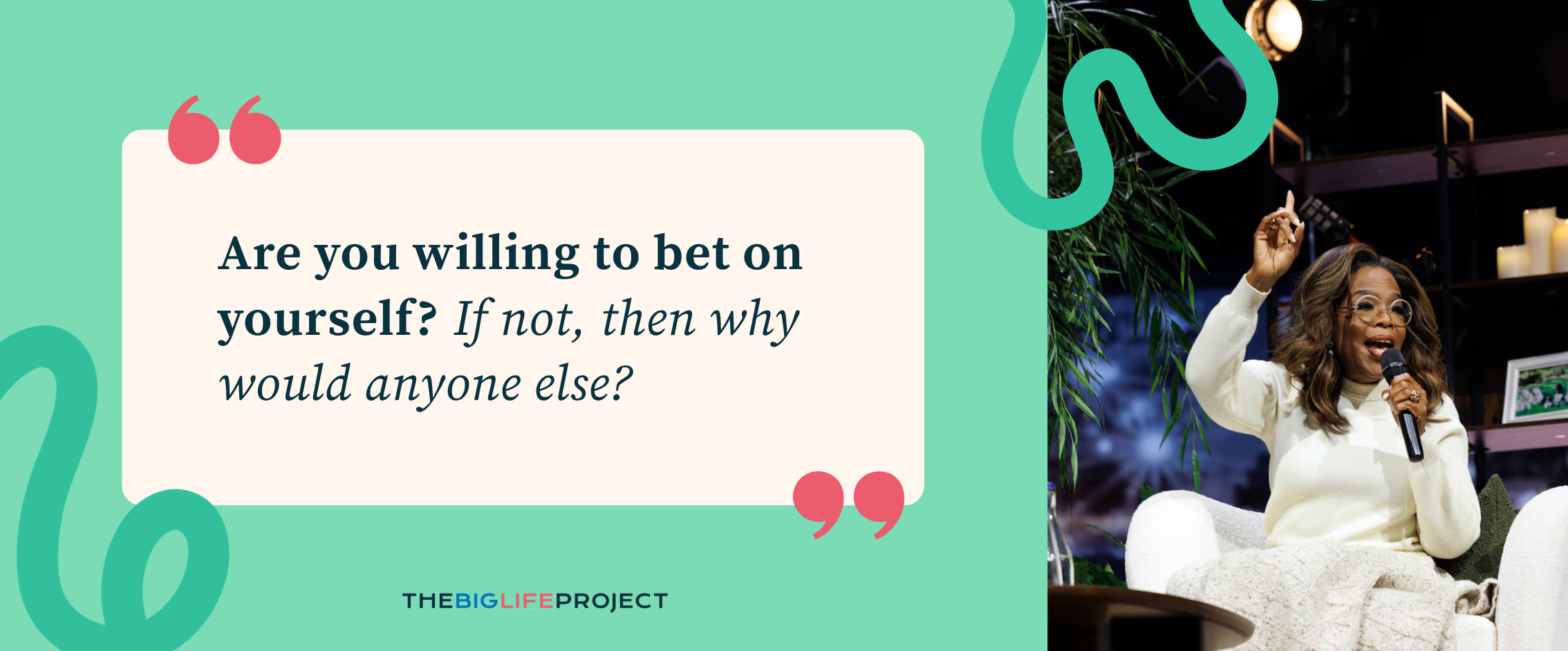
Now you have the space: What do you share about yourself?
Once you’ve taken the microphone or have raised your hand to share, how do you actually do your story justice?
Having interviewed hundreds of people over the course of my career, I can tell you that “Tell me about yourself” is universally the hardest question (and the most critical). The corporate default is to rhyme off qualifications, dates, and safe responsibilities. We give credit away to others, reel off dry statistics, and strip out all personal anecdotes. Suddenly, we become an uncomfortable robot.
When I help clients prepare for interviews or high-stakes presentations, this is always where we begin: preparing a human answer to a human question. Here are three practical shifts to pitch who you are without hiding:
1. Remember: Relatable and messy beats polished every time
When all eyes are on you, the instinct is to rush and minimise your accomplishments just to get out of the spotlight. In that exact moment, remind yourself: people do not connect with bullet points. They connect with people. The more human, real, and relatable you are, the more your story lands.
2. Swap facts for more real, relatable human talk
If you find yourself turning into a fact robot, break the pattern by leading with what genuinely energises you. Start your next sentence with warm, human phrases like:
“What I’m most passionate about is…”
“People I work with often describe me as…”
“My favourite career moment so far was when…”
Opening with genuine passion changes your vocal tone, settles your posture, and makes you instantly memorable.
3. Breathe! Get comfortable with a 3-second pause
When adrenaline spikes, a single second of silence feels like a lifetime. To everyone else in the room, it feels like a nanosecond, just the natural breathing room their brains need to catch up.
Make it a conversation rather than a solo performance. Introduce one intentional pause while counting to three in your head. Notice how people react, make eye contact, and bring them into the moment with you. Suddenly, you aren't alone on a stage; you’re in a dialogue.
Expect it not to go to plan… not perfectly anyway.
Like building any muscle, learning to pitch yourself authentically takes practice. And let’s be real: it won't always go to plan! Just start expecting that instead.
The more human you allow yourself to be, the more vulnerable you will feel. If you are anything like me, you will rarely walk away from an interview, talk, or pitch feeling like you delivered a 10/10 performance. Do not beat yourself up. Instead of replaying every little stumble, replace that critical voice with: “Well done for having the guts to go for it.” Shake it off, take the learning, and try again next time.
You don't need a flawless script to take up space. You just need to step up to the mic, bring your humanity into the room, and own your story.
Are you inspired to take up the space you deserve and own your story?
Whether you're preparing for major job interviews, stepping into leadership visibility, or navigating a career pivot, learning to articulate who you are is where real change begins.
Explore 1:1 Coaching for Moments That Matter to prep for high-stakes interviews, presentations, and pivotal conversations.
Join The Big Life Project Group Programme to quiet self-doubt, unlearn the corporate “shoulds,” and design your next career chapter with clarity and confidence.
Schedule a 30 minute online call to meet and explore how coaching might benefit you (with no obligation or commitment.